THE PROJECT
What is TeleHeartGuard
TeleHeartGuard – Post Acute Coronary Syndrome Tele Heart Monitoring – is a cross-border project focused on the care and monitoring of patients recovering from Acute Coronary Syndrome.
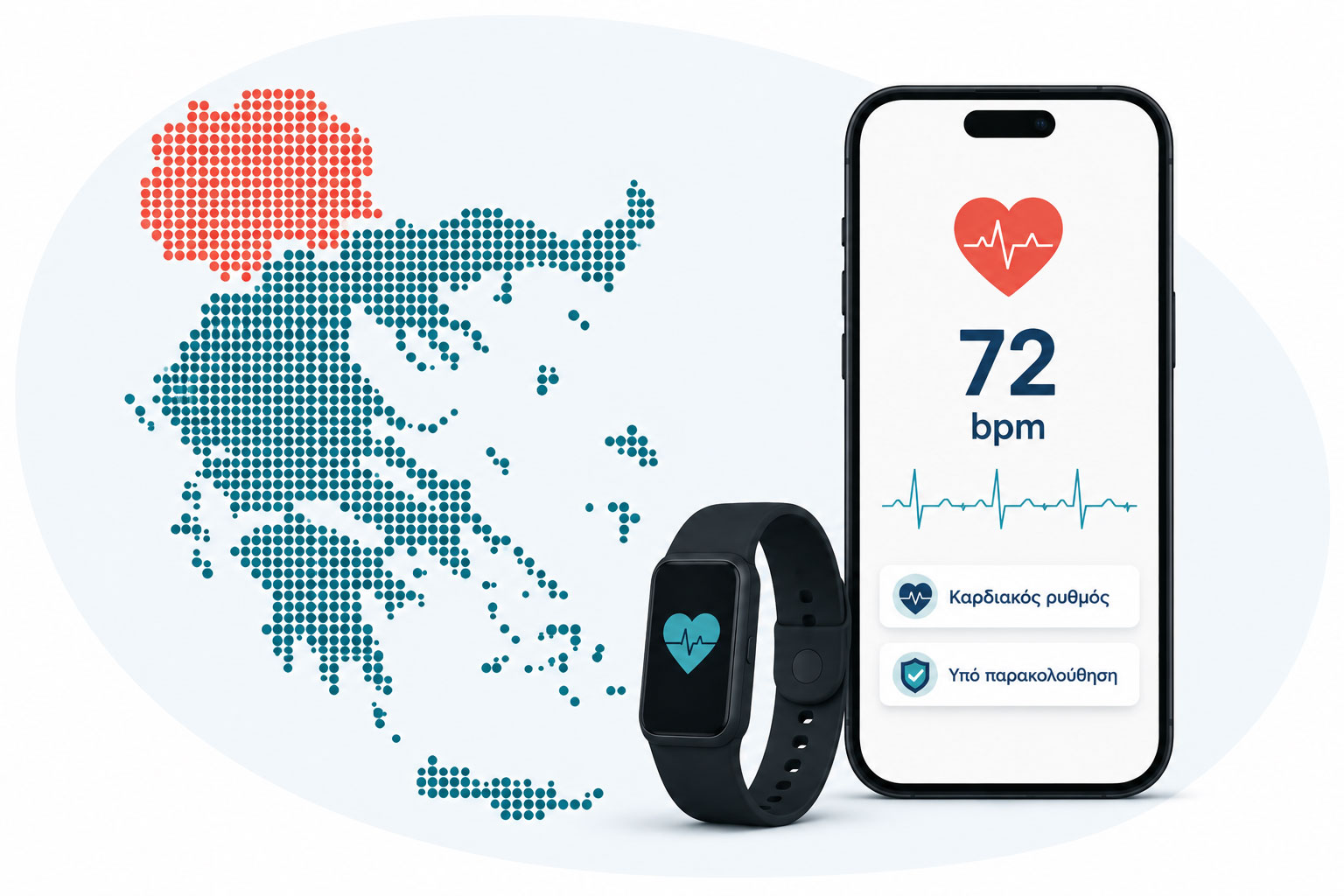
The project combines wearable monitoring devices with a digital platform for managing health data. In this way, selected low-risk patients can return home earlier and safely while remaining in contact with and under the supervision of their care team.
TeleHeartGuard strengthens access to modern healthcare services and promotes a more patient-centred, efficient and collaborative model of care in the Greece–North Macedonia cross-border area.
KEY INFORMATION
TeleHeartGuard at a glance
Project title
Acronym
MIS
Programme
Lead Partner
Implementation area
PROJECT OBJECTIVES
What TeleHeartGuard aims to achieve
TeleHeartGuard aims to create a safer, more connected and patient-centred model of cardiac care in the cross-border area.
- Strengthening safety and continuity of care after the patient's discharge from hospital.
- Using wearable devices and digital tools for the remote monitoring of key health data.
- Facilitating the timely and safe return home of selected patients.
- Maintaining the patient's connection with the medical and nursing team.
- Exchanging knowledge and good practices among the participating hospitals.
- Developing a shared cross-border model of telecardiology care.
- Improving access to high-quality healthcare services in the cross-border area.
- Making more effective use of hospital resources and infrastructure.
PROJECT OBJECTIVES
How TeleHeartGuard works across the cross-border region
The TeleHeartGuard project introduces innovative telemonitoring solutions for patients recovering from Acute Coronary Syndrome (ACS), aiming to improve equal access to secondary cardiovascular care while reducing costs and pressure on hospital resources. By combining wearable devices, artificial intelligence and new treatment protocols, the project enables patients to be discharged earlier and monitored safely at home, boosting both quality of care and hospital efficiency.
The project focuses on four major hospitals across the cross-border region: Papageorgiou General Hospital and G. Papanikolaou General Hospital in Thessaloniki, Greece, and the Clinical Hospital Dr. Trifun Panovski in Bitola and the General Hospital in Strumica, North Macedonia. Activities extend from hospital wards to patients’ homes, improving healthcare access for both urban and rural populations.
Papageorgiou General Hospital, as Lead Beneficiary, coordinates the project, manages the common patient monitoring platform, and oversees training sessions. G. Papanikolaou General Hospital leads protocol development, healthcare professional engagement and dissemination events. The Clinical Hospital in Bitola installs new monitoring equipment, pilots remote patient management and trains medical staff, while the General Hospital in Strumica focuses on applying the protocols, organizing public events and ensuring widespread communication of results.
The project will equip four cardiology clinics with 60 wearable monitoring devices linked to a unified AI-enabled patient data platform. It will develop two new cross-border treatment protocols, train 10 medical experts and 50 healthcare professionals, and inform 250 local doctors on digital cardiology practices. In addition, a cross-border innovation roundtable with 20 hospitals will demonstrate the new technologies and protocols.
TeleHeartGuard directly benefits 3,200 ACS patients annually, their families, and caregivers, while also improving service quality for an additional 10,500 patients undergoing cardiovascular procedures in the partner hospitals. Healthcare professionals, local doctors, and medical staff gain advanced digital health skills, while national healthcare systems benefit from reduced costs and increased hospital capacity.
The project will reduce the average hospital stay of ACS patients by 3 days, increase cardiology clinic capacity by 40% (allowing 1,280 additional patients per year), and lower costs by approximately €508 per incident, saving more than €1.6 million annually for national health systems. These outcomes enhance patient recovery, reduce risks of in-hospital complications, and provide sustainable long-term improvements in healthcare delivery across the cross-border region.